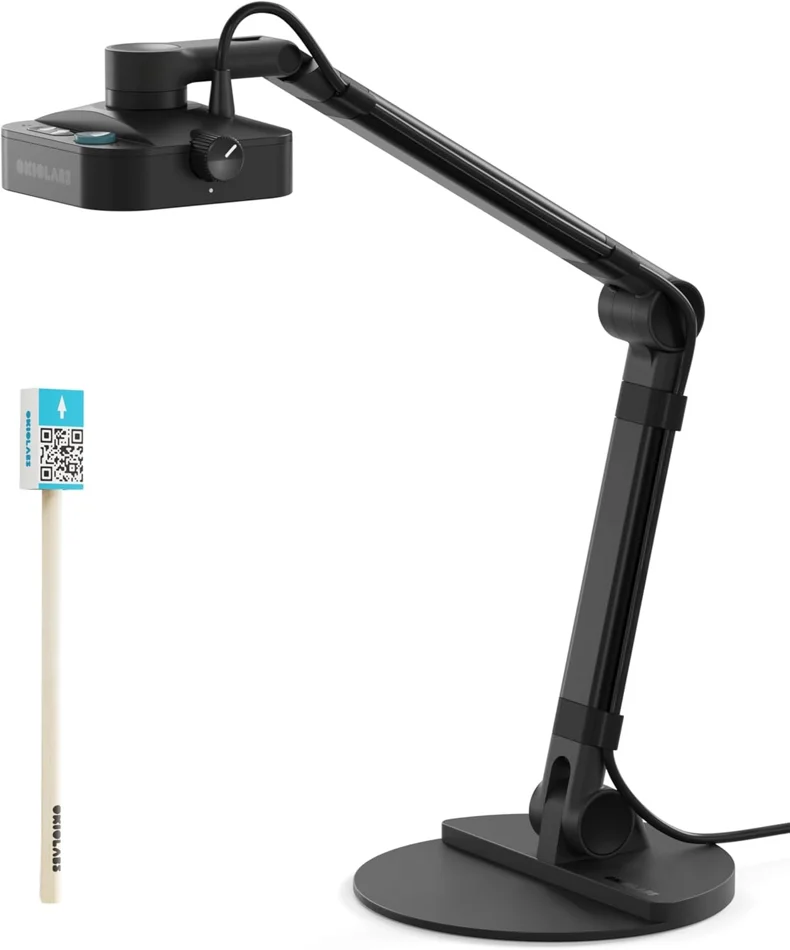
Camera Clarity for Documents and Hands
Use this section as a practical lens while comparing document cameras. The goal is not a flashy gadget; it is a clearer way to show physical materials during remote work, teaching, training, and hybrid meetings.
See the current product shortlist in 5 Best Document Cameras for Remote Work when you are ready to compare models.
Image Clarity. A document camera should make text, diagrams, handwriting, product details, and desk demonstrations readable without forcing viewers to guess. Resolution matters, but focus behavior and compression inside video calls can matter just as much. For camera clarity for documents and hands, the best test is whether remote viewers can understand the material without extra apologies or repeated adjustments.
Image Clarity check. Place a printed page, a notebook, and a small object under the camera. The useful model keeps edges clear enough for remote viewers to follow the explanation.
Lighting Control. Remote work setups often have window glare, overhead shadows, and uneven desk lamps. A practical document camera should handle ordinary lighting or include useful lights without washing out white paper. For camera clarity for documents and hands, the best test is whether remote viewers can understand the material without extra apologies or repeated adjustments.
Lighting Control check. Check whether the page stays readable when a hand moves across it. Shadow control is important for live annotation, product walkthroughs, and teaching.
Arm And Framing. The camera arm should position easily over a page, laptop-side workspace, or demonstration object. If framing is slow or the arm drifts, every call starts to feel clumsy. For camera clarity for documents and hands, the best test is whether remote viewers can understand the material without extra apologies or repeated adjustments.
Arm And Framing check. Look for stable adjustment and enough height to capture full pages while still zooming into details when needed.
Call Workflow. Compatibility with Zoom, Meet, Teams, recording tools, and screen-sharing routines matters. The best camera behaves like a dependable input rather than a special project every time a meeting starts. For camera clarity for documents and hands, the best test is whether remote viewers can understand the material without extra apologies or repeated adjustments.
Call Workflow check. A good workflow test is switching between face camera, screen share, and document view without confusing the audience.
Desk Footprint. Remote desks are crowded with laptops, lamps, notebooks, keyboards, and cables. A document camera needs enough base stability without stealing the whole workspace. For camera clarity for documents and hands, the best test is whether remote viewers can understand the material without extra apologies or repeated adjustments.
Desk Footprint check. Measure the open desk area and think about storage. Foldable or compact designs help if the camera is not used every day.
Teaching And Demos. For tutoring, training, craft demos, forms, invoices, samples, or hardware walkthroughs, the camera should support a calm pace. Viewers need to see what the presenter means without repeated refocusing. For camera clarity for documents and hands, the best test is whether remote viewers can understand the material without extra apologies or repeated adjustments.
Teaching And Demos check. Imagine explaining a process step by step. The camera should stay steady while hands move, pages turn, or small objects are rotated.
Remote-work rehearsal. Run a realistic call in your mind: open the meeting, switch to the document camera, show a page, point to a line, write a note, move an object, and return to the main camera. The best setup makes those transitions smooth enough that the presenter can focus on the explanation.
Viewer perspective. The viewer does not see the desk; they see only the framed image. That means alignment, lighting, and focus have to communicate context quickly. A document camera that looks fine to the presenter can still feel confusing if the audience sees tilted pages, clipped corners, or dim handwriting.
Cable and software simplicity. Remote workers need reliability. Simple USB behavior, clear app requirements, and predictable camera selection reduce support problems. If a camera needs a fragile driver or a confusing capture utility, it may be a poor fit for everyday calls even when the sensor looks good.
Shared team use. Some offices use document cameras across training rooms or hybrid desks. Label cables, store the camera safely, and keep quick-start notes nearby. A shared device should be easy enough for a new presenter to use without turning the first five minutes into setup time.
Content type match. Match the camera to what will actually be shown. Text-heavy paperwork needs sharp focus; craft or product demos need good color and depth; teaching may need a wide page view; hardware demos may need a stable arm that can hover above small parts.
Buying shortlist rule. Prioritize readable output, stable positioning, lighting control, simple compatibility, and desk fit. Extra features are helpful only if they support the main task: making physical materials understandable to people who are not in the room.
Failure mode check. Common failures include blurry text, glare on glossy pages, a shaky arm, software not appearing in the meeting app, and a base that crowds the keyboard. Compare each shortlist option against these ordinary frustrations before buying.
Final setup note. The right document camera should earn a permanent spot in the remote-work toolkit. It should fold or store neatly, launch without drama, and make live explanation clearer than holding papers up to a webcam. That practical difference is what turns a camera from a gadget into useful work equipment.
Presenter comfort. A document camera should make the presenter calmer, not more self-conscious. If the setup requires constant hand hovering, page nudging, or software checking, the audience feels that friction. A stable viewing zone lets the presenter point, annotate, and explain at a normal pace while remote viewers keep their attention on the material.
Training-room reality. Remote-work document cameras are often used for onboarding, compliance walkthroughs, design reviews, tutoring, craft steps, and quick visual proof during support calls. Those uses need repeatable framing more than cinematic polish. A camera that reliably shows the same desk area every time can be more valuable than one with complicated effects.
Desk organization. Plan where papers, pens, samples, and the laptop will sit before choosing a camera. A base that blocks the notebook or a cable that crosses the demonstration area can interrupt the workflow. Good desk organization keeps the camera ready while preserving space for the actual work being shown.
Software fallback. Even if the camera has its own app, it should still behave well as a standard camera source when possible. Remote workers may switch between meeting tools, browser recorders, and learning platforms. Broad compatibility reduces the risk that a useful device becomes tied to one fragile workflow.
Quality review method. Compare options with a simple scorecard: readable text, stable arm, tolerable lighting, fast camera selection, compact storage, and clear value for the tasks you repeat most. This method keeps the decision grounded in actual remote-work needs rather than chasing maximum resolution alone.
Audience patience. Remote viewers are patient when the material is clear and the presenter moves confidently. They become frustrated when the page is sideways, the focus hunts, or the presenter apologizes for the camera. Choose a setup that reduces those little interruptions because they shape how professional the whole session feels.
Long-term fit. A document camera should still feel useful after the first week. If it is easy to pull into a call, easy to put away, and obvious enough for a teammate to use, it has a better chance of becoming part of the routine. Durability, storage, and predictable behavior deserve as much attention as the headline specs.
Page-size planning. Consider the largest material that needs to appear on screen. A camera that handles sticky notes may not frame legal forms, sketch pads, textbooks, or wide product samples. If the presenter often switches between small labels and full pages, zoom range and arm height become practical requirements rather than nice extras.
Meeting etiquette. Good visual equipment supports meeting etiquette. It lets the presenter prepare the page before sharing, keeps private notes outside the frame, and reduces awkward pauses while everyone waits for focus. That calm flow helps remote viewers trust the explanation and stay engaged through technical details.
Remote-work camera decision reminder
Return to the LeStallion document camera review after checking text clarity, lighting, arm stability, video-call behavior, and desk footprint.
Related cloud-chain reference: the previous support page covered Bluetooth conference speakers, another remote-meeting tool kept near the end of the research path.